Traditional enterprise data centers have long struggled with the friction of physical networking. Provisioning a new VLAN, securing an inter-tier application boundary, or routing traffic between subnets historically meant logging into physical switches, coordinating firewall change windows, and navigating hardware vendor sprawl.
VMware NSX changes this paradigm by doing for networking and security what the ESXi hypervisor did for compute: decoupling network functions entirely from the physical hardware substrate.
1. The Core Architecture: Underlay vs. Overlay#
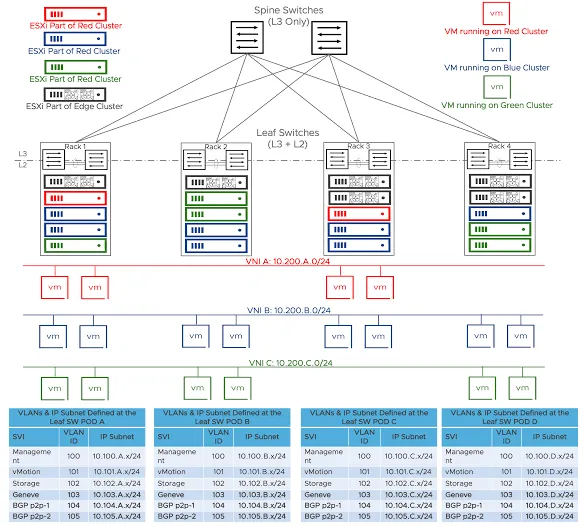
At its technical core, VMware NSX builds a software-defined overlay network on top of a standard IP transport network (the underlay).
How It Operates:#
- The Physical Underlay: Operates as a routed Layer-3 spine-leaf fabric whose sole responsibility is moving packets reliably between hypervisor hosts with high throughput and equal-cost multi-pathing (ECMP).
- Geneve Encapsulation: NSX encapsulates virtual machine traffic inside Geneve (Generic Network Virtualization Encapsulation) frames. This allows Layer-2 segments (identified by Virtual Network Identifiers, or VNIs) to span across distinct Layer-3 racks without spanning-tree protocol limitations or VLAN trunking constraints.
- The NSX Transport Node: Each ESXi host runs native NSX kernel modules. Switching, distributed routing, and firewall inspection occur directly inside the hypervisor kernel at the virtual network adapter (vNIC) layer.
2. Multi-Tiered Routing: Tier-0 and Tier-1 Gateways#
Routing in modern NSX environments is distributed and hierarchical, structured around Tier-0 (T0) and Tier-1 (T1) logical gateways.
Distributed Routing vs. Centralized Services#
- Distributed Routing (DR): Every hypervisor host participates in routing. Inter-subnet east-west routing occurs locally in the hypervisor memory without sending packets up to a physical core switch (hairpinning / tromboning).
- Tier-1 Gateways (Tenant / Application Tier): Dedicated to specific tenants, applications, or workload domains. Application owners can attach segments and manage downstream policies without administrative access to the physical network.
- Tier-0 Gateways (Provider / Physical Fabric Tier): Bridges the virtual overlay with the physical network using BGP or static routing. The T0 gateway handles north-south traffic entering and exiting the datacenter.
- Service Routers (SR): Centralized router instances hosted on NSX Edge clusters that execute stateful operations requiring centralization (such as NAT, Edge Firewalling, VPN, and DHCP).
3. Microsegmentation & Zero-Trust Security#
In perimeter-only network designs, once an attacker compromises a perimeter firewall, they can move laterally across internal subnets with minimal resistance.
Why Microsegmentation Transforms Security:#
- Granular vNIC Enforcement: The NSX Distributed Firewall (DFW) attaches inspection rules directly at the VM's vNIC interface. A VM sitting on the exact same Layer-2 subnet and VLAN as a compromised neighbor cannot be accessed unless an explicit rule permits it.
- Dynamic Grouping & Tags: Policies are not bound to static IP addresses. Security groups evaluate VM names, tags, guest operating systems, or Active Directory identities. If a new web server VM is provisioned with the tag
env=prod; tier=web, it automatically inherits the production web security profile instantly. - Line-Rate Throughput: Because packet inspection occurs in kernel space on the local host CPU, firewall processing scales horizontally with compute additions rather than funneling into a fixed physical firewall appliance.
4. Key Enterprise Use Cases#
- Datacenter Modernization & Consolidation: Accelerates Day-2 provisioning times from weeks to seconds via Infrastructure as Code (Terraform, Ansible, PowerCLI).
- Zero-Trust Workload Isolation: Enables compliance isolation (PCI-DSS, HIPAA, SOC 2) without physical air-gapping or complex VLAN management.
- Disaster Recovery & Multi-Site Federation: Stretches network segments across physical locations, enabling seamless VM mobility and disaster recovery cutovers without IP renumbering.
Comments
No comments yet. Start the conversation.